

It may come as a surprise, but my income portfolio didn’t just generate income: it also delivered equity-like returns. My portfolio outperformed most major indexes, including the S&P 500 Total Return Index and the MSCI World Net Total Return Index. It performed in line with the Nasdaq-100 Total Return Index and slightly below the MSCI Emerging Markets Net TR. In reality, Petrobras was the main engine of this performance. Technology exposure played a secondary role, mainly through my position in JPMorgan Nasdaq Equity Premium Income ETF. The key lesson from these first 15 months is that it is possible to build an income-focused portfolio and still achieve strong total returns, although a significant part of this outcome was driven by favorable market conditions. When in doubt, remember one essential principle: luck is rewarded just as much as talent. That’s the takeaway I’m learning by keeping this portfolio journal.
I/ Why I Outperformed Since Inception
A/ The Raw Numbers: 30.07% Total Return, 12% Yield
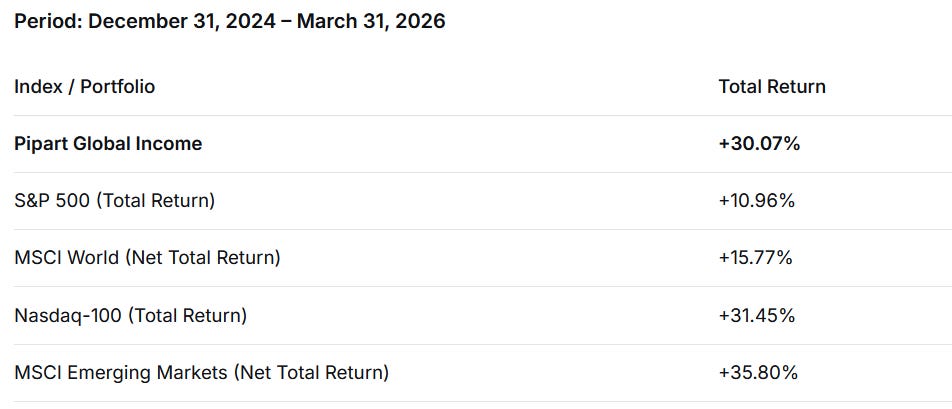
Unlike what you usually see in income investing, we’ll start by looking at the portfolio’s performance in terms of total return. And here, things are pretty clear. The portfolio (+30.07%) beats the S&P 500 (+10.96%) and the MSCI World (+15.77%). I was honestly surprised — especially since I only check my portfolio’s performance every three months, and that’s also when I share updates with the community.
That said, I didn’t beat the Nasdaq-100 (+31.45%) or the MSCI Emerging Markets index (+35.80%), which did slightly better. With those initial results, anyone who reads me regularly can probably guess what’s in the portfolio. To put it simply: the covered call fund JEPQ, and above all Petrobras, are what got me to this very solid level of performance (+30.07%). In other words, it was tech and oil that drove my gains.
B/ What I Owe to Luck
1/ Oil and Iran...
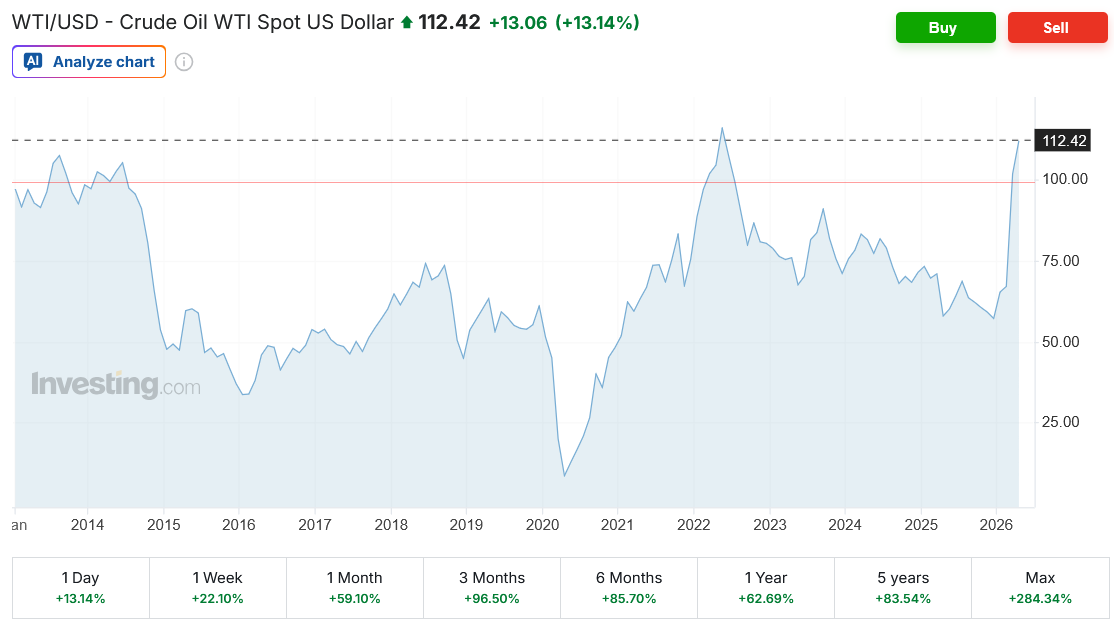
First, oil is my main engine. More than half of my gains came from Petrobras alone. I knew this was an excellent long-term bet, but I didn’t expect it to happen this fast. The escalation in the Middle East accelerated the process. That’s the luck part. Still, let’s remember that I’m betting on a long-term structural rise in the cost of oil — and in the cost of energy more broadly. Back to the facts: as of April 3 after the close, WTI was trading at $112.42. I believe Petrobras’s dividends will be strong in the coming months.
Source: Investing
2/ Tariffs...
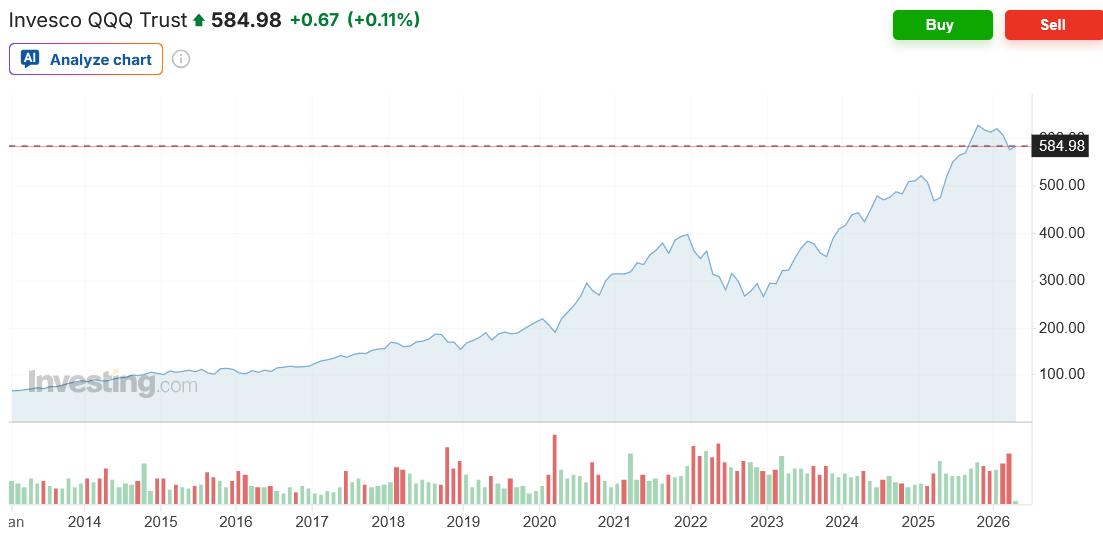
Luck was on my side once again. Markets pulled back on renewed tariff tensions, which created a short-term entry opportunity. That’s because I invested gradually throughout 2025 and entered JEPQ in March 2025. Just look at the dip. It was fortunate timing. So, a shout-out to my broker for asking for so much extra paperwork and, in doing so, accidentally boosting my performance. To be completely honest, though, that stroke of luck had less impact on my portfolio’s performance than the price of oil did.
C/ What I Owe to Strategy
And now we can get back to fundamentals and the long term. Those are the only aspects I’m truly comfortable with. And they serve as my investing compass. Because while oil prices have risen sharply, they will come back down after the crisis... but eventually go up again, since the megatrends are still in place. If you want a refresher, it’s here: Building a Long Term Income Portfolio from Scratch - Part 1 - Pipart Global Income 10%+ Yield.
The bet on chronic underinvestment in oil production has, it seems, paid off. And the geopolitical hedge worked well. As for currency risk, I don’t have much perspective yet, but I’m not fully USD. It’s a start. The bet on tech, though I admit I’m more hesitant on that front, also paid off. My bet on Asia is still too small, and after 15 months, I still haven’t found the ideal vehicle. We’ll go through each position one by one in the next section.
II. My Strategy for 2026 and Long-Term Approach
A/ The I-CASH Method drives the strategy
We stick to the method (Investing in One Country Could Sink Your Portfolio – Part 2 - Pipart Global Income 10%+ Yield) with patience and discipline, and we draw the consequences. That’s the key. Obviously, after 15 months, we can’t yet mechanically apply the logic because there are still many imbalances.
The I-CASH Method remains my compass:
Internationalization → still too light on Asia
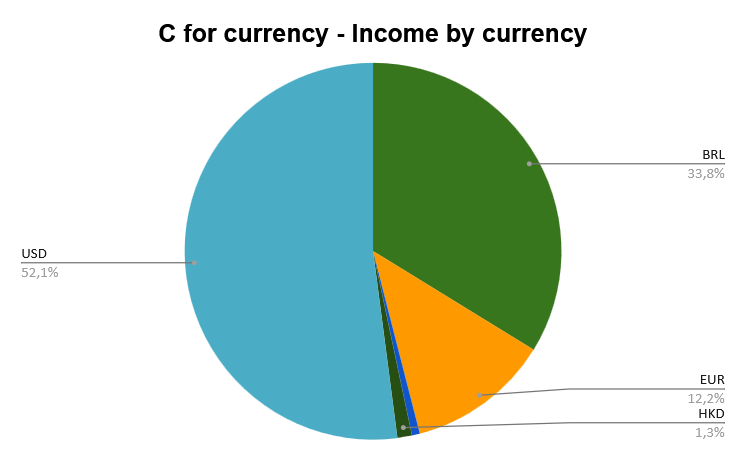
Currency → USD + BRL = 85,9 % → priority euro
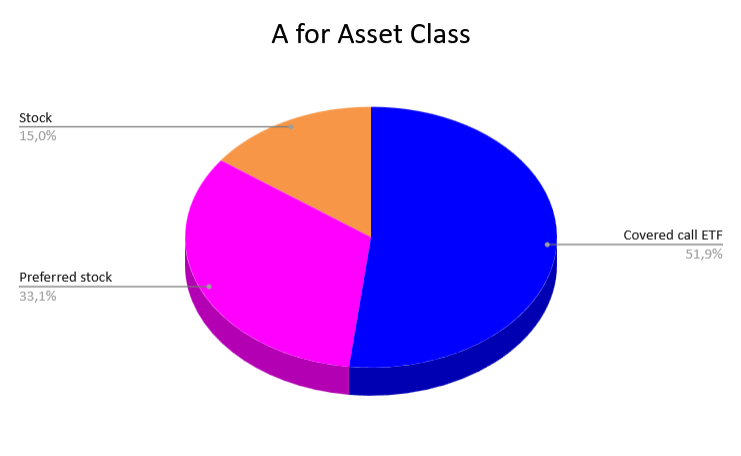
Asset Class → too heavy on covered calls
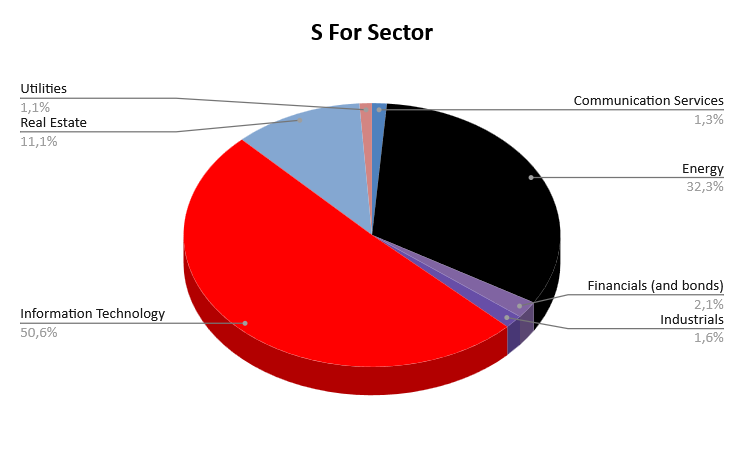
Sector → reduce tech & energy relative weight
High Yield → no change needed
So let’s start with the “I” for Internationalization. And here, the conclusion is clear: I lack exposure to Asia. And it would be wise to diversify investments across North America (Canada and Mexico) and Europe (only three countries involved so far). The strategy rollout is not complete.
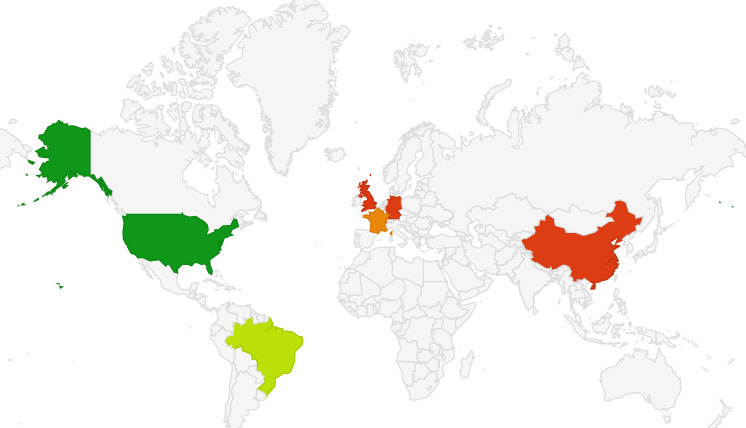
C for Currency Diversification. On this front, the chart below tells us two things. First, the USD is too dominant (52.1% of the portfolio). The same goes for the Brazilian real (33.8% of the portfolio). Second, diversification is not yet complete. At this stage, I believe I need to increase the share of euro-denominated income first, before even considering a more thorough international diversification. That’s my priority for 2026, no second thoughts about it. Diversify first among major currencies.
A for Asset Class. The verdict is clear: I’ve invested way too much in covered call ETFs. I admit they’ve served me very well since the portfolio’s inception. But still, I went too far, and it’s not certain that I’ll be able to adjust this as early as 2026. Let’s move on to determine what choices need to be made starting next week.
S for Sector. Here again, I need to reduce the relative weight of tech and energy. Those two initial bets paid off. They are still good long-term bets. I’m not selling my positions unless something truly exceptional happens. So now, dividends will buy everything except these two sectors. That allows us to sketch out a picture of the portfolio and its priorities. And H for High Yield doesn’t raise any particular questions. It’s time to act, because decisions on what to buy need to be made starting Monday.
B/ Where Should I Reinvest my Dividends? Megatrends, Strategy and Timing
1/ What Can I do ?
At this stage, the takeaway is that I should strengthen my investments in Asia and Europe. In the short term, I haven’t found any suitable investment vehicle in Hong Kong or Singapore yet. However, in Europe I still have interesting targets, particularly ETFs based on the DAX 40 (trailing P/E ≈ 17.5x – 18.1x) and the Euro Stoxx 50 (trailing P/E ≈ 15.4x / forward P/E ≈ 13.9x). These two indices offer historically reasonable valuations, with the Euro Stoxx 50 appearing particularly attractive compared to the DAX and especially versus much more expensive U.S. markets.
This takes care of the currency and internationalization issues. As for asset classes, I feel somewhat at a loss at this stage, because to execute my international diversification, I haven’t found any other vehicles. I’m going to have to accept this shortcoming and set a long-term goal to fix it. The trade-off is this: I absolutely need to increase my monthly income outside of USD. The ETFs I’ve identified are, in my view, perfect for meeting these objectives. As for the sector dimension, I’m more comfortable there. The field is fairly open. Still, I have a strong desire to increase my industrial exposure.
2/ Let’s go for European ETFs
Now that we’ve laid out all our objectives — some of which are contradictory or out of reach — it’s time to make a call. Forward to Europe and, if possible, industry. This translates into two decisions. One is already old and on a very small position I’ve already started: I will keep buying DYLD (read here: Double Digit Yield in Germany? - Pipart Global Income 10%+ Yield), which in my view is a European industrial ETF, denominated in euros. That’s perfectly on target.
It is also time to test another European ETF: SYLD (Global X Euro Stoxx 50 Covered Call UCITS ETF). This fund applies a covered call strategy on the Euro Stoxx 50, delivering a double-digit dividend yield while maintaining exposure to Europe’s largest and most established companies. It offers a well-balanced sector allocation with strong weights in Financials (21%), Consumer Discretionary (19%), Industrials (17%), and Technology (16%). Denominated in euros, SYLD will help me increase my European exposure, boost euro-denominated income, and add industrial tilt to the portfolio. I will give it a modest allocation initially (exactly as I did with DYLD) to test how it fits into the overall strategy.
Investment Takeaway
Those who have read the whole article deserve a “present”: the list of my holdings. In terms of price return only, the clear winners in my portfolio are Petroleo Brasileiro (PBR.A) with a very strong +60% and Banco do Brasil (BDORY) at +17%, supported by good performances from JEPQ (+7%), XYLD (+8%), and LGGNY (+6%). On the losing side, we have Edvantage Group (-12%), NATY (-8%), PFFI (-4%), JEPG (-1%), and Icade (-2%), while DYLD is flat. Ultimately, my only real disappointments are Icade and Edvantage Group. These two underperforming positions are not particularly concerning, as I still fully stand by my long-term investment thesis on both.
But let’s turn to the bottom line. In 15 months, I’ve exceeded all my total return goals. Honestly, just staying close to the S&P 500 already seemed like an ambitious target. So strategy and luck worked hand in hand. But let’s be honest: the coming period will likely be less rewarding, and reinvesting dividends into new sectors is essential. My choice to focus on Europe is one of wisdom and stability, and it won’t generate performance of this magnitude. That’s the wisdom of the method.
Either way, the portfolio’s CAGR since inception stands at 23.61%. I’ll probably look back on that with nostalgia in a few years, but the goal now is to grow the income and make it more secure. Because this is an income portfolio. And I don’t intend to rely solely on luck.
Liked this Deep-Dive? Buy Me a Coffee!
Your support keeps this newsletter independent and research-driven. If this analysis saved you time or gave you a new investment idea, consider making a one-time donation. Every contribution helps me maintain part of the research free and accessible to everyone.